

Titanium Plate in Offshore Power Station
In the construction and operation of marine power stations, the choice of materials directly affects the performance, life and reliability of power generation equipment. Titanium alloys have excellent properties such as low density, high specific strength and creep resistance, and have great potential in the field of marine energy. Specifically, the use of titanium plates provides a solid guarantee for the stable operation of these plants. In addition, the introduction of simulation technology has brought new breakthroughs and developments for the application of titanium plates in this field.
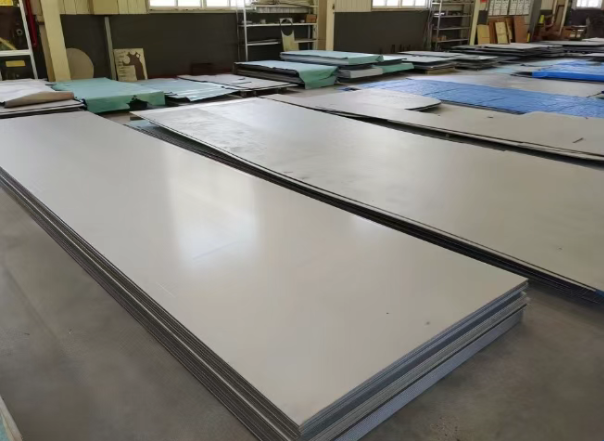
compatibility
titanium alloys effectively reduces component weight while maintaining structural strength. This is of great significance for the installation and operation of large-scale equipment in marine power plants, reducing the requirements for supporting structures and reducing energy consumption. The high specific strength ensures that the titanium alloy can withstand the impact of huge water pressure and wind and waves, while the creep resistance ensures the dimensional stability under long-term high temperature and high pressure environment and prevents the equipment from failing due to deformation.
However, titanium alloys also exhibit low ductility, high deformation resistance and significant anisotropy, making them extremely sensitive to hot deformation process parameters. The precise control of these parameters during the titanium sheet forming process is a key challenge to achieve ideal microstructure and properties.
Simulation Technology: Solving Heat Treatment Challenges
-
thermal simulation:. Using a thermal/mechanical simulator for compression testing, researchers can obtain flow stress curves. For example, studies on the TA15 titanium alloy have shown that dynamic recrystallization is the dominant softening mechanism of the $ \ alpha $phase, while dynamic recovery is dominant in the $ \ beta $phase. These findings help engineers avoid defects such as cracks or uneven structures.
-
numerical simulation:optimize processes and reduce costs. The numerical simulation can reproduce the hot working of titanium alloy on computer. For example, simulating the forging of TC21 titanium alloy allows quantitative analysis of the $ \ alpha $phase morphology. By adjusting the temperature and strain fields according to these results, the mechanical properties of the titanium plate can be optimized to meet strict marine standards.
-
microstructure evolution simulation:material properties. Unlike traditional "trial and error" methods, numerical simulation of microstructures provides a powerful tool to quantify the relationship between process parameters and material properties. This ensures that the titanium plate has excellent corrosion resistance, strength and toughness in harsh marine environments.
Advantages, Challenges and Future Prospects
simulation technology shortens the development cycle and reduces costs, which is essential for expensive materials like titanium. While challenges remain-such as data accuracy and complexity of boundary conditions-the future lies in the integration of physical and numerical simulations. Combining the macro-finite element model with the micro-evolution model will achieve real-time quality control and move the industry towards more reliable and efficient marine clean energy production.


